
SmartDOST Direct Selling (MLM) Software vs Traditional Software: Key Differences | SmartDost

The Direct Selling industry in India
has evolved significantly. As a distributor networks grow and business models
become more sophisticated, companies need software that can do more than manage
basic sales or customer records. They need a platform that understands Direct
Selling operations, distributor networks, compensation plans,
commissions, KYC, reporting, payouts, and applicable Direct
Selling rules and compliance requirements.
This is where the difference between
traditional ready-made software and purpose-built Direct Selling (MLM)
software becomes important.
While many age-old software
solutions can be configured for different businesses, they may not have been
originally designed around the unique operational requirements of Direct
Selling. SmartDost by SmartSoft takes a different approach: a refined,
industry-focused platform designed around the evolving needs of Direct
Selling businesses in India.
Traditional
MLM Software vs Purpose-Built Direct Selling Software
Traditional software is generally
developed to serve broad business requirements such as CRM, accounting,
inventory, sales, or customer management. Such systems can be usefulbut
adapting them to a distributor-driven business model may require additional
modules, customizations, integrations, or manual processes.
Purpose-built MLM software,
on the other hand, is designed around the way a Direct Selling business
actually operates.
|
Business
Requirement |
Traditional
/ Ready-Made Software |
SmartDost |
|
Distributor Management |
May require customization |
Designed around distributor
operations |
|
Genealogy |
May require additional development |
Integrated network management |
|
Compensation Plans |
Often adapted through
configuration |
Built around MLM compensation
logic |
|
Commission Management |
May involve separate processes |
Connected with compensation
workflows |
|
KYC & Onboarding |
General-purpose workflows |
Direct Selling-focused workflows |
|
MIS & Network Reporting |
Often requires custom reports |
Designed for MLM business visibility |
|
Compliance Considerations |
May need additional configuration |
Considered within operational
workflows |
|
Scalability |
Depends on architecture and
customization |
Designed for growing Direct
Selling networks |
The difference is therefore not
simply about the number of features. It is about how deeply the software
understands the Direct Selling business model.
Why
SmartDost Is Different
Built
for Direct Selling, Not Adapted to It
One of the fundamental differences
between SmartDost and traditional software is the approach to product design.
A general-purpose platform may begin
with a standard business architecture and later be modified to accommodate MLM
requirements.
SmartDost is designed specifically
around the operational needs of Direct Selling businesses. This means
key processes such as distributor management, genealogy, compensation,
commissions, KYC, and reporting are considered as connected parts of the same
business environment.
The objective is not simply to
digitize existing processes, but to optimize them through an integrated
system.
Optimized
Distributor Management and Genealogy
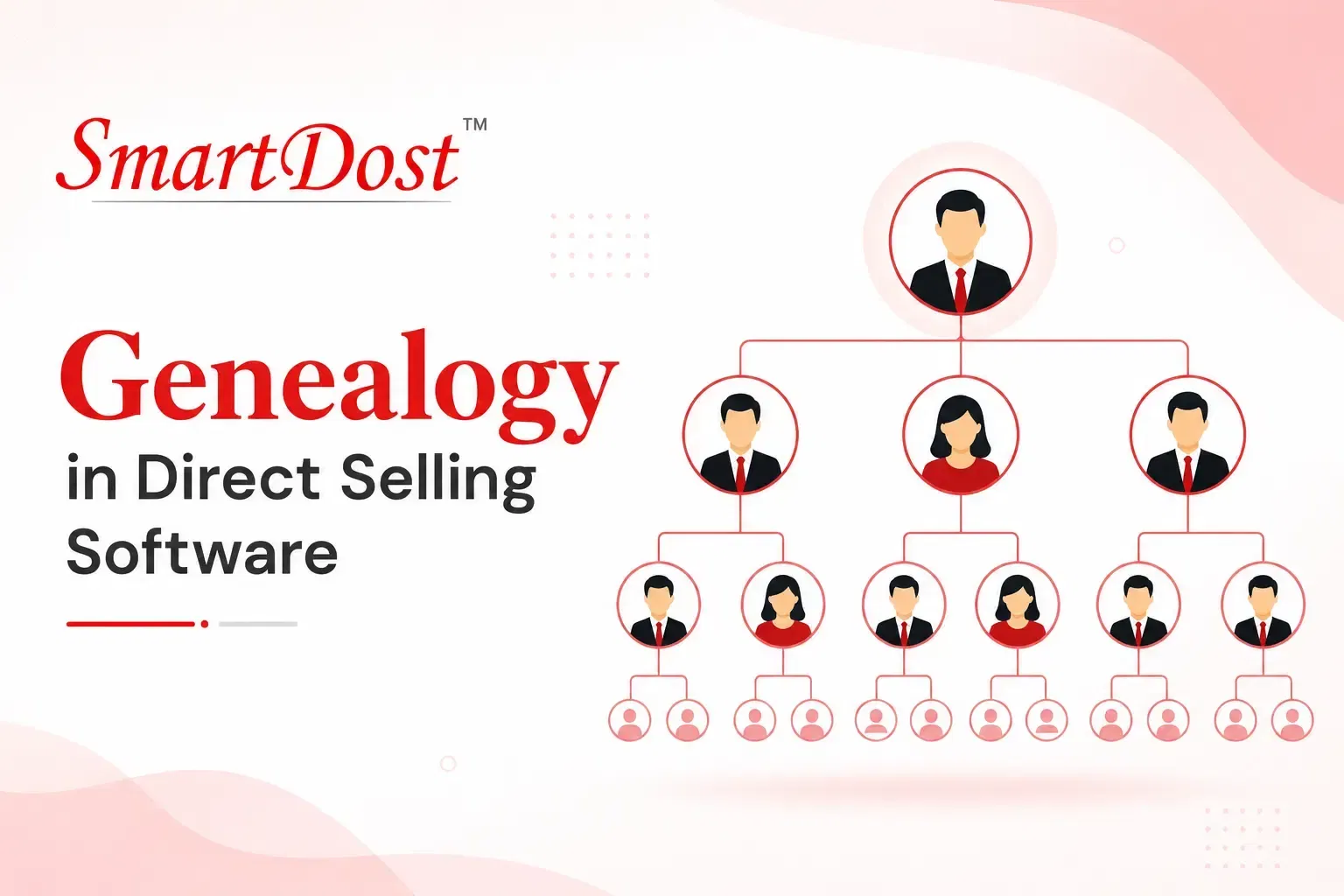
Distributor networks are at the
heart of Direct Selling.
A distributor may have a sponsor,
placement, direct referrals, and a wider downline network. Managing these
relationships through conventional customer-management software can become
increasingly complicated as the network grows.
SmartDost
provides structured distributor management and genealogy management,
helping businesses maintain visibility into network relationships and
distributor activity.
This creates a more suitable
foundation for managing a growing Direct Selling organization.
Flexible
Incomes Plan Management
Every Direct Selling business may
have its own approach to distributor incentives and payouts. Incomes structures
can include sales matching bonus (binary), unilevel, generation,
and hybrid models.
Traditional software may not be
designed to understand these structures and may require significant
customization to accommodate them.
SmartDost supports multiple variety
of income plans, helping businesses manage compensation logic according to
their operational requirements.
This flexibility becomes particularly
important when businesses modify or expand their income structures as they
grow.
Distributor
OnboardingAndIntegrated KYC
Distributor onboarding is another
area where generic software may fall short.
A Direct Selling organization may
need to manage registration, distributor information, KYC documentation,
verification, bank details, and activation as part of its onboarding process.
SmartDost brings KYC and
distributor onboarding into the broader distributor management workflow,
helping businesses maintain organized information and reduce dependence on
disconnected manual processes.
Commissions,
Payouts and Business Reporting
A Direct Selling platform must
connect business transactions with distributor income calculations.
Commission calculations can depend
on sales, network relationships, income rules, eligibility, and other business
parameters. Similarly, management teams need visibility through MIS reports,
distributor reports, genealogy reports, commission reports, and business
performance information.
SmartDost connects these operational
areas within a common environment, helping businesses reduce manual
reconciliation and improve visibility across their distributor network.
Designed
with Direct Selling Rules & Compliance in Mind
The Indian Direct Selling industry
operates within a regulatory environment where businesses need to consider
applicable Direct Selling rules & compliance requirements.
Depending on the business and
transaction structure, this may include considerations related to GST, TDS,
distributor KYC documentation, payouts, and record keeping.
SmartDost is designed with
compliance-oriented workflows in mind, helping businesses incorporate relevant
operational considerations into their processes rather than treating compliance
as an entirely separate activity.
Specific regulatory obligations can
vary by business and should be reviewed with appropriate professional advisors.
Why
Age-Old Ready-Made Software May Become Restrictive
An older ready-made platform may
continue to serve basic business requirements effectively. The challenge arises
when a Direct Selling company needs its software to evolve with its business
model.
Businesses may encounter:
● Separate systems for different functions
● Manual reconciliation between modules
● Custom development for MLM requirements
● Limited flexibility on Income plan calculations
● Accuracy challenges in large networks data
● Additional effort to manage genealogy
● Disconnected KYC and onboarding
● Custom reporting requirements
These limitations do not necessarily
mean traditional software is unsuitable for every business. However, they
highlight why industry-specific software can be more effective when
Direct Selling operations are the primary requirement.
SmartDost:
A Refined Software Approach for Modern Direct Selling
SmartDost by SmartSoft is built
around a clear objective: provide a purpose-built Direct Selling software
platform that brings essential business processes together.
From distributor management
and genealogy to compensation plans, commissions, KYC,
MIS reporting, payouts, and compliance-oriented workflows, the platform
is structured around the requirements of modern Direct Selling businesses in
India.
As distributor networks grow and
business processes become more complex, having software designed for the
industry can help organizations move away from fragmented processes and toward
a more connected operational environment.
Conclusion
The real difference between
traditional software and Direct Selling (MLM) software is not simply the
feature list. It is the underlying approach.
Traditional ready-made software is
generally built to serve broad business needs and may require adaptation for
Direct Selling. SmartDost takes an industry-focused approach, with its functionality
structured around the operational requirements of Direct Selling businesses
in India.
With integrated distributor
management, genealogy, income plan management, commission
processing, KYC, MIS reporting, and compliance-oriented
workflows, SmartDost provides a refined approach to managing Direct Selling
operations.
For businesses looking for software
that is not merely adapted to Direct Selling but designed around it,
SmartDost offers a purpose-built platform aligned with the evolving needs of the
industry.
Frequently
Asked Questions
1.
What is Direct Selling (MLM) software?
Direct Selling (MLM) software is specialized business software designed to manage
distributor networks, genealogy, income plans, commissions, KYC, payouts,
sales, and business reporting. Unlike general-purpose software, it is
structured around the operational requirements of Direct Selling businesses.
2.
How is Direct Selling software different from traditional software?
Traditional software is generally
designed for broad business functions such as CRM, accounting, sales, or
inventory. Direct Selling software is specifically designed to manage
distributor networks, genealogy, compensation plans, commissions, onboarding,
and MLM-specific reporting.
3.
Why is purpose-built MLM software better suited for Direct Selling businesses?
Purpose-built MLM software is
designed around the actual workflows of a distributor-based business. This can
reduce the need for extensive customization, separate systems, and manual
reconciliation that may be required when adapting traditional software to
Direct Selling operations.
4.
What makes SmartDost different from traditional ready-made software?
SmartDost
is designed specifically around the operational requirements of the Direct
Selling industry. It brings distributor management, genealogy, compensation
plans, commissions, KYC, reporting, and compliance-oriented workflows together
rather than treating them as disconnected functions.
5.
Can SmartDost support different compensation plans?
Yes. SmartDost supports
multiple MLM compensation plans, including binary, unilevel, generation,
and hybrid structures, helping businesses manage compensation according to
their operational requirements.
6.
Does SmartDost support distributor genealogy management?
Yes. SmartDost provides genealogy
management and distributor network tracking, helping businesses manage
sponsor relationships, placements, and distributor network structures within a
common platform.
7.
Does SmartDost provide KYC and distributor onboarding?
Yes. SmartDost incorporates
distributor onboarding and KYC workflows, helping businesses organize
distributor information and documentation as part of the onboarding process.
8.
How does MLM software help with commission management?
MLM commission software connects business transactions with compensation rules and
distributor payouts. This can help businesses manage commission calculations
more systematically and reduce dependence on spreadsheets and manual
reconciliation.
9.
Can Direct Selling software support compliance requirements in India?
Direct Selling businesses in India
may need to consider applicable Direct Selling rules and compliance
requirements, as well as tax-related considerations such as GST and TDS
depending on their business and transaction structure. SmartDost is designed
with compliance-oriented workflows in mind. Specific regulatory requirements
should be evaluated with appropriate professional advisors.
10.
Is traditional software suitable for a Direct Selling business?
Traditional software can handle
general business functions, but it may require additional customization or
integrations for distributor management, genealogy, compensation, commissions,
and MLM reporting. A purpose-built Direct Selling software platform can
be more suitable when these functions are central to the business.
11.
What should I look for when choosing MLM software?
Businesses should evaluate compensation
plan support, distributor management, genealogy, KYC, commission and payout
management, reporting, scalability, security, integrations, and
compliance-oriented workflows. The software should be able to support both
current operations and future business growth.
12.
Why is software scalability important for Direct Selling businesses?
As a distributor network grows, the
number of distributors, transactions, genealogy relationships, commissions, KYC
records, and reports can increase significantly. Scalable Direct Selling
software helps businesses manage growing operational complexity without
relying excessively on disconnected tools or manual processes.